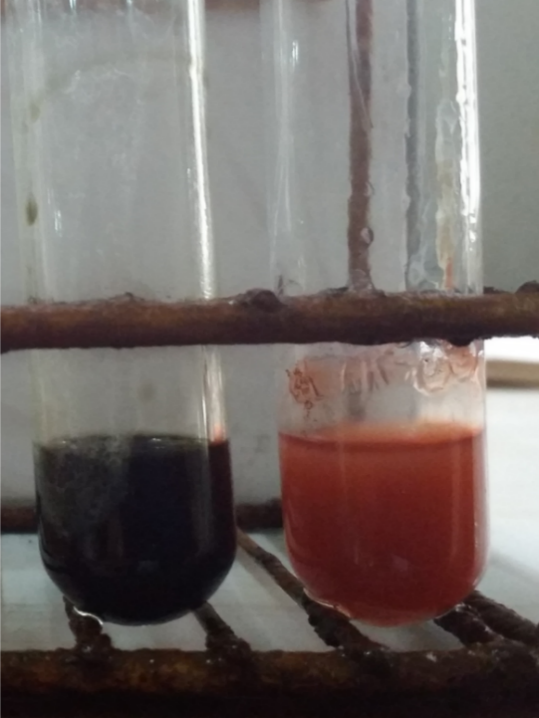
<b>Background</b>: From centuries of evolution, knowledge and technological progress for mankind to one day rediscover nature. Currently, the control of bacterial infections is becoming complex due to the concern of antibiotic resistance, which has been a significant global health problem. The aim was to determine and compare phytochemical constituents and in the <i>in</i><i> </i><i>vitro</i> evaluation of antimicrobial and antioxidant activities of aqueous, methanol, acetate, dichloromethane extracts from <i>Cola</i><i> </i><i>acuminata</i> nuts grown in the Nord Ubangi Province, DRC. <b>Methods</b>: The nuts of <i>Cola</i><i> </i><i>acuminata</i><i> </i>were harvested in April 2016 at Yakoma city, Nord-Ubangi, DRC. The microscopic features of this species were performed in order to identify specific histological structures. Three bacterial strains notably <i>Staphylococcus</i><i> </i><i>aureus</i> ATCC 25923, <i>Escherichia</i><i> </i><i>coli</i> ATCC 8739 and <i>Pseudomonas</i><i> </i><i>aeroginosa</i> ATCC 9027 were used for the assessment of the antibacterial activity. The qualitative and quantitative phytochemical screening were used for compound identification using different fractions and fractions which presented a good extraction yield was used for further analysis. The antioxidant activity was evaluated using ABTS and DPPH scavenging tests while the antibacterial activity was performed using the diffusion method. <b>Findings</b>: The micrography of <i>C.</i><i> </i><i>acuminata</i><i> </i>revealed the presence of following histological elements of which: fibers, spiral vessels, trichomes, ovoid starch grains, sclerenchyma and the fragments of endosperm. Only the methanol and aqueous extracts presented a good extraction yield. The phytochemistry shows the presence of flavonoids, anthocyanins, terpenes, iridoids and tannins. All fractions showed IC<SUB>50</SUB> values lower than 10 µg/mL in the ABTS test and lower than 100 µg/mL in the DPPH test. The antibacterial activity of this plant was low against the three strains used. <b>Conclusion</b>: Seeing the potency of <i>C.</i><i> </i><i>acuminata</i> and different biological activities displayed, further analysis are required in order to identify and purify the active ingredients, to study the toxicity of cell lines <i>in</i><i> </i><i>vitro</i>, to perform the in vivo experiments and to test for other activities such as the anti-hypoglycemic and anti-inflammatory.