
Abstract
This study investigates whether the Feedback Literacy Scale (FLS) can be developed and validated to measure student teachers’ feedback literacy in teacher education in Myanmar. Based on the Feedback Literacy Scale (FLS) by Yildiz et al. (2020) [1], the Student Feedback Literacy Scale (SFLS) developed by Liao (2021) [2], and the Student Feedback Literacy (SFL) scale by Woitt et al. (2023) [3], the Feedback Literacy Scale was validated. Firstly, the item pool for the feedback literacy scale contained 76 items. The participants of this study were 1550 from 360 first-year, 367 second-year, 378 third-year and 445 fourth-year student teachers. The exploratory factor analysis resulted in a four-factor structure, and the final confirmatory factor analysis indicated acceptable model fit. The final scale demonstrated strong internal consistency and acceptable validity and reliability for use with Myanmar student teachers in teacher education. Therefore, the Feedback Literacy Scale (FLS) was found to be valid and reliable for measuring feedback literacy of student teachers of the teacher education program in Myanmar. This study indeed helps student teachers, school administrators and education policymakers improve their understanding of feedback and application of feedback in their learning for future professional teaching in the Myanmar teacher education program.
1. Introduction
No systematic conception of teaching or learning because teaching is something one does, not something one studies. Learning is generally defined as the process by which behaviour is developed or altered through practice or experience. In Myanmar, teacher education has been undergoing curriculum reforms since 2016. In Asian countries, Vietnam, Thailand and Laos have also implemented these curriculum reforms. Nowadays, the Myanmar education system is gradually changing and introducing new curriculum reforms and educational practices for preparing student teachers who are more active, reflective, independent and aligned with the curriculum development in the teacher education sector. Feedback has become the focus of a considerable and expanding body of research investigating its role in student learning. Feedback is an important element that increases success in the teaching-learning process in higher education, as it is at all levels of education. A growing number of recent studies have examined feedback and its impact on student learning in higher education (Evans, 2013) [4]. Feedback plays an important role in learning, and the main purpose is to bridge the gap between a desired learning goal and the current performance (Evans, 2013) [4]. According to Hattie and Timperley (2007) [5], feedback serves to answer these three broad questions: Where am I going (feeding up to learning setting or expected standards that a learner works towards)? How am I going (feeding back on a learner’s actual level of performance about goals and standards)? And where to next (feeding forward to greater possibilities for learning)? Traditionally, feedback is perceived as information generated and delivered from teachers to students. This transmission model is based on a cognitive perspective, and teachers are considered the ones mainly responsible for the effect of feedback (Boud & Molloy, 2013; Evans, 2013) [4, 6]. This conceptualisation is still very much present in the ways teaching quality and student experience are measured in higher education (Winstone & Carless, 2021) [7], which, to some extent, has also influenced how teachers and students see feedback (Winstone et al., 2021) [7].
Feedback has become an important part of the teaching and learning process because it supports students’ learning improvement and also helps to achieve effective performance. Although feedback is an essential part of teaching and learning, many studies related to feedback literacy are still limited in Myanmar. Feedback literacy has been proposed to conceptualise the capabilities that students need to engage in feedback. Feedback literacy is thought by its proponents to be a worthwhile outcome in and of itself, as well as may means of supporting students in engaging in feedback and, ultimately, in improving their learning. Feedback literacy is important for developing skills among student teachers, as the success of Myanmar’s current education reforms.
There was no study to examine feedback literacy among universities and colleges in Myanmar. For Myanmar teacher education institutions, there was no standardised and validated feedback literacy scale specifically designed to measure student teachers’ feedback literacy. Most feedback literacy scales were created and tested in Western countries. Therefore, researchers need reliable and valid instruments to measure student teachers’ feedback literacy when measuring this concept in Myanmar’s teacher education context. The researcher intends to validate the new feedback literacy scale and intends to explore the feedback background of student teachers in teacher education. Without an appropriate measurement instrument, teacher educators may face difficulties in recognising the specific areas in which student teachers require assistance. The resources were created in educational environments that promote self-directed learning and facilitate communication between students and teachers. The researcher simply translates foreign instruments without examining whether the scales are reliable and suitable for the local context. This situation makes it difficult to obtain accurate data about student teachers’ feedback literacy.
2. Literature Review
2.1. Concept of feedback
A significant challenge in optimising feedback is the diversity of its interpretation. Teachers and learners frequently report different views of what feedback is and what it means (Carless, 2006) [8]. Consequently, feedback strategies tend to be haphazard, without due consideration for instructional design (Esterhazy & Damsa,2019) [9]. Feedback, which is regarded as an important factor influencing learning (Eraut, 2006) [10] and an essential component of learning (Cramp, 2011) [11]. At this point in the feedback process, teachers or students should ask themselves questions about what skills they want to develop, how close they are to achieving their goal, and what they should do next (Hattie & Timperley, 2007; Brookhart, 2008) [5, 12]. Teachers' written comments on students' assignments, which are a one-way transmission of information from teacher to student, have been the most popular form of feedback for many years (Malecka et al., 2020) [13]. For students and teachers to share responsibility in the effective feedback process, Carless and Winstone (2020) [14] also emphasised the significance of feedback literacy. The development of feedback literacy among students will provide insight into how to address issues with the application of feedback (Malecka et al., 2020) [13].
2.2. Effective feedback
Effective feedback refers to feedback information with specific characteristics provided to students in response to their work or performances to optimise learning. Effective feedback is students’ perception of how the format, timeliness, amount, specificity, complexity, and tone of feedback (Shute, 2008) [15] should be to facilitate engagement with feedback. Effective feedback needs to address the right amount of information with proper specificity to respond or work. According to Wiggins (2012) [16], consistent, continuous, and timely feedback are interdependent. Therefore, feedback information is effective when multiple and compatible pieces of information are constantly conveyed to learners at the right moment.
2.3. Characteristics of feedback
Feedback is delivered in a variety of specific forms to maximise learning effectively. According to Shute (2008) [15], the complexity of feedback concepts and types of feedback are classified as no feedback, verification, correct response, error flagging, elaborated, hints/cues/prompts, and informative tutoring. When there is no feedback, students are supposed to present a task, response, or performance, but they are not given any information about its correctness. Tedick and Gortari (1998) [17] stated that if the feedback is elaborated, it elicits the reason for the correct answer. When the feedback recognises the learners’ efforts to continue with desired performance and accomplishments in the expected direction while encouraging them to improve poor performance, it is called constructive feedback (Ovando, 1994) [18]. In this way, feedback is given in such a specific way that learners are encouraged to take a positive attitude towards their performance and to progress in line with the desired goals and standards (Bee & Bee, 1994) [19].
2.4. Feedback literacy
The definition of feedback literacy was originally derived from Stiggins’ (1991) [20] assessment of literacy. Carless and Boud (2018) [21] propose that feedback literacy involves students developing an appreciation of the value of feedback and their active role in its processes. The importance of feedback literacy is underscored by significant recent interest. In a significant conceptual framing of feedback literacy, Carless and Boud (2018) [21] propose that feedback literacy involves students developing an appreciation of the value of feedback and their active role in its processes. According to Sutton (2012) [22], students primarily enhance their capacity to comprehend feedback on and for knowing. Feedback on knowing is originally based on evaluation and correction (Hattie & Timperley, 2007) [5].
2.5. Student feedback literacy framework (Carless & Boud, 2018)
As a new contribution, Molloy et al. (2020) [23] designed their framework of Student Feedback Literacy and interpreted its major features from a learner-centred perspective. However, most of the features (e.g., appreciating feedback, seeking it from multiple sources, managing emotions, receiving/providing feedback, and responding to it) were also mentioned in Carless and Boud’s (2018) [21] framework.
Carless and Boud (2018) [21] described in their framework of student feedback literacy four interrelated components, namely appreciating feedback, making judgments, managing emotions, and taking action. To make the most of feedback processes, Carless and Boud (2018) [21] emphasised the active role of students in making evaluative judgments. Feedback- literate students develop their capacities when making sound academic judgments about their work, and they participate productively in peer feedback processes and refine their self- evaluative capacities.
2.6. Theoretical foundation of feedback literacy
Piaget’s (1969) [24] developmental view and Bruner’s (1961) [25] discovery of learning are the origins of constructivism. Constructivism is a combination of multiple approaches, mainly cognitivism and behaviourism. According to Carless & Boud (2018) [21], the construct of student feedback literacy primarily emphasises students’ understanding of feedback information to use it for future work, thereby promoting and improving learning.
3. Materials and Method
3.1. Research Questions
The study aims to develop and validate the Feedback Literacy Scale (FLS) for teacher education in Myanmar. It addresses the following three research questions:
- RQ 1. How can the feedback literacy scale be developed for student teachers in teacher education?
- RQ 2. Is the resulting FLS Psychometrically reliable and valid?
3.2. The Study Sample
A quantitative method (Descriptive Survey Design) with a random sampling method. This study selected 1550 student teachers for survey questions from eight Education Degree Colleges under the Department of Teacher Education in Myanmar as the sample. The participants were selected by a random sampling method. A total of 100 student teachers participated in pilot testing from Taunggyi Education Degree College in Myanmar to check comprehension and clarity of instructions, and test the preliminary reliability.
3.3. Instrumentation of the feedback literacy scale
In developing the scale, the researcher referred to several related instruments. Student Feedback Literacy Scale (SFLS), developed by Liao (2021) [2], contained 31 items with 4 dimensions: Appreciation Feedback, Making Judgment, Managing Affect, and Taking Action. The overall Student Feedback Literacy Scale has a Cronbach’s alpha of those 31 items, were 0.944 and 0.87 for appreciation feedback, 0,83 for managing affect, 0.88 for making judgment, and 0.88 for taking action. Examples of statements are “I understand and appreciate the role of feedback in improving my work.” (appreciation feedback), “I develop abilities to make sound academic judgments about my work.” (making judgment), “I always embrace opportunities to evaluate my own work before it is graded.” (managing-affect), and “I develop a range of strategies for acting on feedback.” (taking action).
The Feedback Literacy Scale, developed by Yildiz et al. (2022) [1], contained 24 items with four factors: Appreciation, Positive attitude, Awareness Feedback, and Openness Feedback. In Yildiz’s study, Cronbach’s alpha for the overall scale was 0.87 and for each of the four subscales was 0.88, 0.88, 0.84 and 0.83. An example of a statement is “I improve academically by means of feedback (appreciation) “When I receive feedback, I feel that my work is valuable. (positive attitude)”, “I think that feedback should be given appropriately. (awareness feedback)”, and “I act in accordance with the feedback given (openness feedback).”
The Student Feedback Literacy Scale (SFLS) was developed by Woitt et al. (2023) [3]. This questionnaire consists of 21 items and two factors. The reliability coefficient of the scale in this study was 0.86. Examples of statements are “I handle feedback on a feedback level instead of taking it personally (Feedback Practices)” and “I believe that I can contribute to the value of feedback processes (Feedback Attitude).”
4. Factor analysis results and findings
RQ 1. How can the feedback literacy scale be developed for student teachers in teacher education?
In order to find the answer to the first question, exploratory and confirmatory factor analysis were applied to determine the study sample's responses for each field of study and each item on the questionnaire.
According to widely accepted guidelines for factor analysis, an adequate sample size is essential for producing stable and reliable results. Exploratory factor analysis was conducted using data from 775 participants drawn from four Education Degree Colleges, which exceeds the minimum threshold and therefore meets the recommended criteria for a robust factor analytic procedure.
To investigate the feedback literacy scale, 775 student teachers selected from four Education Degree Colleges under the Department of Teacher Education in Myanmar participated as a sample. Before the explanatory factor analysis, the appropriateness of subscales for factor analysis was assessed. Firstly, exploratory factor analysis was used to investigate the number of items and the dimensions of the scale. It was also used to reduce data to a smaller set of summary variables and to postulate that there is a smaller set of unobserved (latent) variables or constructs that underlie the variables that actually were observed. Exploratory factor analysis (EFA) was conducted with 76 items for the feedback literacy scale. There were no items that had a low communality value of less than 0.4.
Table 1 gives information about two assumptions of factor analysis. To determine if the subscales were suitable for factor analysis, the Bartlett Test of Sphericity and KMO (Kaiser-Meyer-Olkin Measure of Sampling Adequacy) tests were used. The first test examined if the subscales of the scale are interdependent, and the latter examined sample sufficiency. As shown in Table 1, ΚΜΟ=0.963 >0.70 indicated that the sample data are suitable for factor analysis (Hair et al., 2006). Bartlett’s Test (p<0.001) showed that the correlation coefficients are not all zero (Table 1). As a result, both assumptions required for factor analysis are satisfied.
Figure 1 shows a scree plot of eigenvalues plotted against the factor numbers. The criterion of Eigenvalue ≥1 was used for determining the number of factors. In Figure 1, the curve has an instant fall after the fourth factor. From this, it could be interpreted that the scale has four factors.
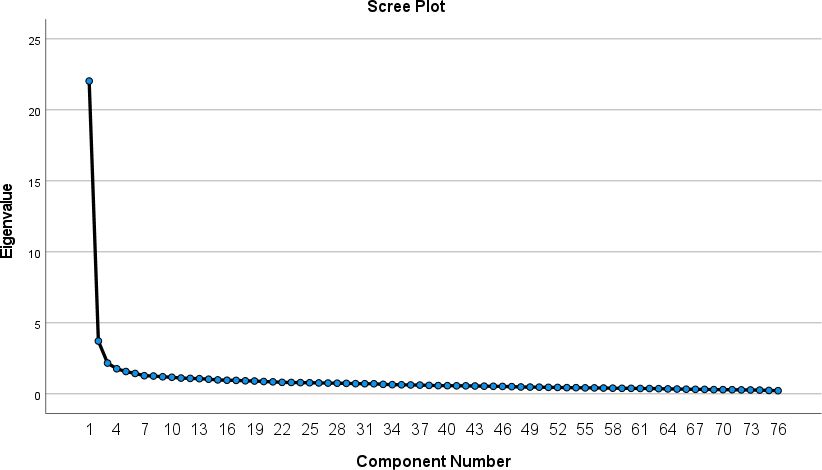
A principal axis factoring was run with Varimax Rotation to check the scale construct validity. After the principal axis factor analysis with varimax rotation, there were 6 items (items 2, 4, 5, 6, 27, and 43) which had a low factor loading value of less than 0.3 and were omitted from the 76 items. According to several steps, some of the items which have high cross-loading (items 22, 23, 28, 37, 44, and 54) were also excluded from the 76 items that were finally used to continue the subsequent procedures.
The resulting four factors explaining 40.42% of the total variance were obtained. The first factor had factor loadings ranging from 0.366 to 0.705, and explained 12.83% of the total variance. The second factor explained 9.73% of the total variance and had factor loadings ranging from 0.402 to 0.594. The third factor obtained 9.11% of the total variance and had factor loadings ranging from 0.388 to 0.692. The fourth factor also explained 8.74% of the total variance and had factor loadings ranging from 0.326 to 0.627. This four-factor feedback literacy scale, consisting of 64 items (see Appendix A), explained 40.42% of the total variance.
Each factor was named in accordance with the construct explained by the items. The first factor could be labelled as “Feedback Information Processing”. The items under this factor were related to interpreting task requirements, analysing feedback messages, identifying standards and cues, seeking clarification, and monitoring one’s learning progress. The factor consists of 22 items with loadings between 0.366 and 0.705 and explains 12.83% of the total variance. Two examples of the statements in factor 1 were: “I analyse and record information in appropriate forms for the purposes of acting on it subsequently,” and “I take into account multiple sources of feedback because they are useful in different ways.”
The items of the second factor were related to capturing learners’ recognition of their strengths and weaknesses, understanding of learning needs, evaluation of their performance, and their ability to reflect on the meaning and purpose of feedback. Considering that, the factor was named “Recognition and Evaluation of Feedback”. Factor 2 consists of 15 items and explains 9.73% of the total variance. The factor loadings of the items listed under this factor ranged from 0.402 to 0.594. Two examples of the statements in factor 2 were: “I believe that I can contribute to the value of feedback processes,” and “When I receive feedback, I recognise my strengths.”
The third factor would be regarded as “Feedback Responsiveness.” This factor consists of items reflecting learners’ behavioural engagement with feedback, such as revising work, planning improvements, refining learning strategies, and using feedback to guide future performance. The factor consists of 14 items with loadings between 0.388 and 0.692 and 9.11% of total variance explained. Two examples of the statements under factor 3 were “I am interested in receiving feedback about my learning,” and “I refer to my previous feedback experiences for judging my overall progress.”
The items of the fourth factor were focused on learners’ emotional reactions to feedback (e.g., feeling confident, motivated, valued, excited) as well as attitudinal dispositions such as openness to receiving feedback, willingness to learn from mistakes, and determination to use feedback for improvement. Considering that, the factor could be named as “Attitude and Emotion of Feedback”. Factor 4 consists of 13 items and explains 8.74% of the total variance. The factor loadings of the items listed under this factor ranged from 0.326 to 0.627. Two examples of the statements under factor 4 were: “When I receive feedback, I feel that my work is valuable,” and “I evaluate my homework/study process by means of feedback.
The Cronbach's alpha values were 0.918, 0.881, 0.888, and 0.871, respectively, for each factor, and the overall feedback literacy scale was 0.962. As a valid and reliable measure for the current teacher education program in Myanmar, the reliability coefficient exceeded 0.7, and the resulting scale was suitable. To obtain a more reliable and consistent scale, confirmatory factor analysis is being conducted.
To confirm the factor structure of the Feedback Literacy Scale, confirmatory factor analysis was conducted with Study 2. The participants consisted of 775 student teachers selected from four Education Degree Colleges different from Study 1 for strong cross-validity. Confirmatory factor analysis (IBM AMOS version 24) with maximum likelihood estimation was performed to test the stability of the constructs in the 64-item Feedback Literacy Scale. There are three types of fit, which are included in the analysis. The model was redefined based on modification indices, and the item with the lowest loading was removed sequentially, followed by a fresh CFA from the beginning. The final model (a total of 48 items with 4 factors) reached the acceptable level of all fit indices. The overall model fit statistics of the analysis are illustrated in Table 2, and the final model fit for the feedback literacy scale is shown in Figure 2.
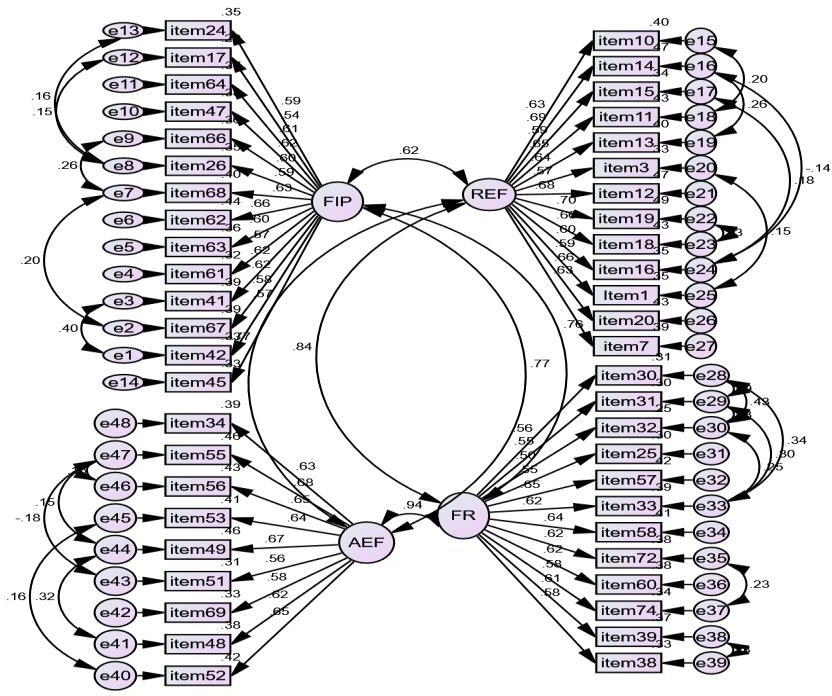
RQ 2. Is the resulting FLS psychometrically reliable and valid?
Content validity was confirmed by ten experts. All items will be translated and culturally adapted. To refine the collected items by asking ten experts who have special knowledge and a close relationship in the field of educational psychology and educational test and measurement were asked to conduct a face validity and content validity review. Experts examined each item to ensure that it was clear, relevant and consistent with the theory. The experts agreed that the items were appropriate and represented correctly the dimensions that were supposed to be measured. Their review suggested that the instrument was conceptually sound and relevant to the audience.
Construct validity was examined through confirmatory factor analysis (CFA). The measurement model finally used demonstrated good fit to the data. The final values of RMSEA, CFI, TLI, and IFI indices were all within acceptable ranges, indicating a good model fit. These results supported the construct validity of the instrument by establishing the theoretical soundness and statistical validity of the measurement model. Reliability of the instrument was evaluated through internal consistency measures.
The resulting total number of 48 items (14, 13, 12, and 9-items for each subscale) was retained, and the reliability coefficient for this feedback literacy scale was defined. Reliability analysis showed that the instrument demonstrated strong internal consistency, with a Cronbach’s Alpha coefficient of .955, and each subscale of feedback literacy was .891, .901, .876, and .858, demonstrating a very high level of internal consistency. According to Nunnally (1978) [26], a construct reliability (CR) value above .70 is considered acceptable, and all CR values in this study’s instrument exceeded .70. These findings suggest that each construct's items consistently measure the same underlying factor and exhibit high variance. Collectively, the high reliability coefficients provide solid evidence that the instrument is dependable and satisfactory for use in further research (see Appendix B).
5. Discussion
This study extends prior research by developing and validating a feedback literacy scale. The data were randomly separated into two datasets: dataset 1 (N = 775) was used for exploratory factor analysis in SPSS 26 to obtain the factorial structure of feedback literacy; dataset 2 (N =775) was used for confirmatory factor analysis in AMOS 24 to examine the goodness-of-fit of the factorial structure. After editing and selection, a total of 76 items were used in the preliminary analysis to conduct statistical validation. The exploratory factor analysis revealed that four separable feedback literacy scales were identified, such as feedback information processing, recognition and evaluation of feedback, feedback responsiveness, and attitude and emotion of feedback, according to the nature of the items loaded in the factors. After EFA results,12 items out of 76 items were eliminated because they had low squared multiple correlation and standardised regression weight. Confirmatory factor analysis was conducted to confirm the factor structure obtained from EFA.
After respecification,16 items out of 64 items were eliminated based on their cross-loading and factor-loading values. The final four-factor model with 48 items was obtained. After preparing the instruments, they were used to measure the feedback literacy of student teachers in Myanmar. The Cronbach alpha for this feedback literacy scale was 0.955, which is valid and consistent across all ASEAN countries because this internal consistency is high compared to the standard value of 0.7 (Nunnally, 1978) [26], and the value of each subscale is also greater than 0.8. Thus, this feedback literacy scale for teacher education is consistent with Carless and Boud’s 2018 feedback literacy Framework.
Thus, the developed scale is a reliable and valid instrument for measuring student teachers' feedback literacy. As the first feedback literacy scale developed and validated in Myanmar, it provides a foundation for future research in teacher education and may be adapted and validated for use in other ASEAN countries as well. Its application can produce systematic and evidence-based data to support teaching quality enhancement, teacher education improvement, and the promotion of quality education across diverse educational contexts.
6. Conclusions and Recommendations
The main purpose of this study is to validate the Feedback Literacy Scale for student teachers of teacher education in Myanmar. A total of 1550 student teachers from education degree colleges participated in this study. Feedback Literacy Scale (FLS), developed and validated, was applied to collect data and to identify student teachers’ feedback literacy levels in teacher education. The result revealed that the feedback literacy scale was consistent and reliable for further use.
This study validated feedback literacy among student teachers in Myanmar Education Degree Colleges. This study demonstrates that the feedback literacy scale is valid to further apply among student teachers in Myanmar, which will be essential for developing reflective practice in their learning. This study developed a valid student teachers’ feedback literacy scale. Therefore, future teachers can provide expert feedback practice that effectively contributes to the advancement of Myanmar’s education system. Enhancing student teachers’ feedback literacy and welfare through training, workshops, and self-regulated practice is essential for improving feedback-literate learners in their future professional teaching.
Appendix A
- Item 42: I recognise and interpret language peculiar to education, containing important cues about the task or related outcomes.
- Item 67: I analyse and record information in appropriate forms for the purposes of acting on it subsequently.
- Item 41: I identify and utilise standards, criteria, and role models.
- Item 61: I manage the emotional challenges of receiving feedback, which may be unwelcome or misjudged.
- Item 40: I seek cues from the environment and the task itself that indicate the appropriateness of work.
- Item 63: I recognise that they have roles as both user and provider of information and that skill in one role helps in the other.
- Item 62: I consider the influence of high-stakes assessment on the way learners might engage in dialogue about their own performance (e.g., declaring their own deficiencies in performance may impact grades, or desire to score well may reduce learners’ receptivity to feedback information).
- Item 68: I monitor my progress to discern where feedback might be helpful and to influence the setting of new learning goals.
- Item 65: I exhibit cultural sensitivity through not assuming that others are likely to react in the same way as oneself in receiving and responding to information.
- Item 26: I engage in dialogue to elicit useful information about standards, criteria, and the nature of good work.
- Item 66: I respond to feedback information from others through goal setting and planning how it might be utilised in future work.
- Item 47: I build trust in facilitating honest information exchanges with others; I build trust in facilitating meaningful information exchanges with others.
- Item 64: I compose useful information for others about the nature of their work.
- Item 17: I feel that I have a responsibility to use feedback to improve academically.
- Item 76: I take into account multiple sources of feedback because they are useful in different ways.
- Item 24: I consider feedback from multiple sources (e.g., teachers, peers, parents…) to provide a different scope and opportunities for learning.
- Item 36: When dealing with feedback, I try to keep my emotional balance.
- Item 73: I act in accordance with the feedback given.
- Item 35: If needed, I seek out further information to better understand a feedback comment.
- Item 45: I demonstrate volition and sensitivity in approaching suitable others to continue dialogue with them as needed.
- Item 75: I assess my learning progress to determine where feedback might be helpful to me.
- Item 59: I take feedback into account for evaluating how well I am navigating a challenge.
- Item 10: When I receive feedback, I learn about the adequacy of my studies.
- Item 14: I recognise my learning needs by means of feedback.
- Item 15: I think that a feedback process is most effective if I take an active role in it.
- Item 11: I use the feedback given to improve my work.
- Item 13: When I receive feedback, I recognise my strengths.
- Item 3: I appreciate the role of the feedback process in improving my work.
- Item 12: I gain different perspectives by means of feedback.
- Item 19: I feel that feedback helps me refine my judgments on my own work.
- Item 18: I believe that one of the main purposes of feedback is for me to improve in my studies.
- Item 16: I believe that I can contribute to the value of feedback processes.
- Item 1: I understand that feedback can help me continually improve my work.
- Item 9: During the feedback process, my communication with the lecturer/teacher increases.
- Item 20: I believe that feedback can come from various sources.
- Item 7: To make feedback effective, it should form a feedback loop.
- Item 21: I really take my time to reflect on feedback I have received.
- Item 30: I think feedback should be explanatory.
- Item 31: I think feedback should be given objectively.
- Item 32: I think feedback should be given in time.
- Item 25: I realise that different stakeholders may have different experiences.
- Item 29: I think that feedback should be given appropriately.
- Item 57: If given the opportunity, I revise my work based on feedback.
- Item 33: I am interested in receiving feedback about my learning.
- Item 58: I refer to my previous feedback experiences for judging my overall progress.
- Item 72: I do self-criticism by means of feedback.
- Item 60: I recognise that feedback information comes in different capacities to vary emotions.
- Item 74: When evaluating feedback, I keep in mind different perspectives and opinions.
- Item 39: I reconsider and refine my learning strategies.
- Item 8: I recognise that feedback should build capacity to develop my evaluative judgment over time on different learning outcomes.
- Item 38: Based on what I learn from feedback, I consider doing things differently in the future.
- Item 52: When I receive feedback, I feel that my work is valuable.
- Item 50: When I receive feedback, I feel happy.
- Item 48: When I receive feedback, my self-confidence increases.
- Item 69: I evaluate my homework/study process by means of feedback.
- Item 51: When I receive feedback, I feel cared for.
- Item 49: When I receive feedback, my motivation increases.
- Item 70: I evaluate whether I have reached the goal or not by means of feedback.
- Item 53: When I receive feedback, I get excited
- Item 71: I use what I learned in other areas by means of feedback.
- Item 56: I strive to make the most of the feedback I have received.
- Item 55: I learn from my mistakes by means of feedback.
- Item 46: I demonstrate openness to receiving feedback from others without displaying defensiveness.
- Item 34: For improving my studies, I use feedback information.
Appendix B
Feedback Literacy Scale
Feedback Information Processing
- Item 42: I recognise and interpret language peculiar to education, containing important cues about the task or related outcomes.
- Item 67: I analyse and record information in appropriate forms for the purposes of acting on it subsequently.
- Item 41: I identify and utilise standards, criteria, and role models.
- Item 61: I manage the emotional challenges of receiving feedback, which may be unwelcome or misjudged.
- Item 63: I recognise that they have roles as both user and provider of information and that skill in one role helps in the other.
- Item 62: I consider the influence of high-stakes assessment on the way learners might engage in dialogue about their own performance (e.g., declaring their own deficiencies in performance may impact grades, or the desire to score well may reduce learners’ receptivity to feedback information).
- Item 68: I monitor my progress to discern where feedback might be helpful and to influence the setting of new learning goals.
- Item 26: I engage in dialogue to elicit useful information about standards, criteria, and the nature of good work.
- Item 66: I respond to feedback information from others through goal setting and planning how it might be utilised in future work.
- Item 47: I build trust in facilitating honest information exchanges with others; I build trust in facilitating meaningful information exchanges with others.
- Item 64: I compose useful information for others about the nature of their work.
- Item 17: I feel that I have a responsibility to use feedback to improve academically.
- Item 24: I consider feedback from multiple sources (e.g., teachers, peers, parents…) to provide a different scope and opportunities for learning.
- Item 45: I demonstrate volition and sensitivity in approaching suitable others to continue dialogue with them as needed.
Recognition and Evaluation Feedback
- Item 10: When I receive feedback, I learn about the adequacy of my studies.
- Item 14: I recognise my learning needs by means of feedback.
- Item 15: I think that a feedback process is most effective if I take an active role in it.
- Item 11: I use the feedback given to improve my work.
- Item 13: When I receive feedback, I recognise my strengths.
- Item 3: I appreciate the role of the feedback process in improving my work.
- Item 12: I gain different perspectives by means of feedback.
- Item 19: I feel that feedback helps me refine my judgments on my own work.
- Item 18: I believe that one of the main purposes of feedback is for me to improve in my studies.
- Item 16: I believe that I can contribute to the value of feedback processes.
- Item 1: I understand that feedback can help me continually improve my work.
- Item 20: I believe that feedback can come from various sources.
- Item 7: To make feedback effective, it should form a feedback loop.
Feedback Responsiveness
- Item 30: I think feedback should be explanatory.
- Item 31: I think feedback should be given objectively.
- Item 32: I think feedback should be given timely.
- Item 25: I realise that different stakeholders may have different experiences in the process.
- Item 57: If given the opportunity, I will revise my work based on feedback.
- Item 33: I am interested in receiving feedback about my learning.
- Item 58: I refer to my previous feedback experiences for judging my overall progress.
- Item 72: I do self-criticism by means of feedback.
- Item 60: I recognise that feedback information comes in different capacities to vary emotions.
- Item 74: When evaluating feedback, I keep in mind different perspectives and opinions.
- Item 39: I reconsider and refine my learning strategies.
- Item 38: Based on what I learned from feedback, I consider doing things differently in the future.
Attitudes and Emotion of Feedback
- Item 52: When I receive feedback, I feel that my work is valuable.
- Item 48: When I receive feedback, my self-confidence increases.
- Item 69: I evaluate my homework/study process by means of feedback.
- Item 51: When I receive feedback, I feel cared for.
- Item 49: When I receive feedback, my motivation increases.
- Item 53: When I receive feedback, I get excited
- Item 56: I strive to make the most of the feedback I have received.
- Item 55: I learn from my mistakes by means of feedback.
- Item 34: For improving my studies, I use feedback information.
Acknowledgements
We want to say thank you to Dr Kay Thwe Hlaing, who's the Rector at Yangon University of Education and to Dr Nyo Nyo Lwin and Dr Soe Soe Aung, who are Pro-Rectors at Yangon University of Education. We want to thank everyone who contributed to this study.
Conflict of Interest Statement
The author(s) declare that there are no conflicts of interest regarding the publication of this research. No financial, personal, or professional relationships have influenced the design, conduct, analysis, or reporting of this study.
Author Approval Statement
All authors have read and approved the final version of the manuscript and agree to its submission for publication.
Authorship Contribution
May Ko Ko Lwe prepared and designed the study, collected and analysed the data, interpreted the results, and drafted the manuscript. Tin Zar Aung supervised the research, contributed to the study design, data interpretation and critically reviewed and revised the manuscript. Khin Hnin Nwe provided technical and academic guidance, and reviewed and revised the manuscript. All authors read and approved the final manuscript.
Author contributions: MKKL: conceptualised and designed the study, conducted factor analysis, and drafted and finalised the initial manuscript; TZA: supervised the research, contributed to the study design, data interpretation and critically reviewed and revised the manuscript; KHN: provided technical and academic guidance, and reviewed and revised the manuscript.
Funding: No funding source reported for this study.
AI statement: In this study, during the preparation of this work, the author used AI to assist with reference finding and initial conceptual ideas. Except for these, we do not use AI-generated words or write in any text within the manuscript.
References
- Yıldız, H., Bozpolat, E., & Hazar, E. (2022). Feedback Literacy Scale: A Study of Validation and Reliability, International Journal of Eurasian Education and Culture, 7(19), 2214-2249.[CrossRef]
- Liao, Y. (2021). Developing and Validating the Student Assessment-Based Feedback Literacy (SAFL) Instrument: A Mixed-Methods Approach. Open Access Theses & Dissertations. 3424. https://scholarworks.utep.edu/open_etd/3424
- Woitt, S., Weidlich, J., Jivet, I., Derya Orhan Göksün, D. O., Drachsler, H., & Kalz, M. (17 Oct 2023): Students’ feedback literacy in higher education: an initial scale validation study, Teaching in Higher Education, DOI: 10.1080/13562517.2023.2263838.[CrossRef]
- Evans, C. (2013). Making sense of assessment feedback in higher education. Review of Educational Research,83(1), 70-120 https://doi.org/10.3102/0034654312474350[CrossRef]
- Hattie, J., & Timperley, H. (2007). “The Power of Feedback.” Review of Educational Research 77 (1): 81–112. doi: 10.3102/003465430298487.[CrossRef]
- Boud, D., & Molloy, E. (2013). Rethinking models of feedback for learning: the challenge of design. Assessment and Evaluation in Higher Education, 38(6), 698-712. https://doi.org/10.1080/02602938.2012.691462.[CrossRef]
- Winstone, N. E., & Carless, D. (2021). Who is feedback for? The influence of accountability and quality assurance agendas on the enactment of feedback processes. Higher Education Research & Development, 1-15. DOI: 10.1080/0969594X.2021.1926221.[CrossRef]
- Carless, D. (2006), ‘Differing Perceptions in the Feedback Process’, Studies in Higher Education 31(2), pp. 219–233.[CrossRef]
- Esterhazy, R., & Dams, C. (2019). “Unpacking the Feedback Process: An Analysis of Undergraduate Students’ Interactional Meaning-Making of Feedback Comments.” Studies in Higher Education 44(2): 260–274. doi:10.1080/03075079.2017.1359249.[CrossRef]
- Eraut, M. (2006). Feedback. Learning in Health and Social Care. P. 5, 111–118.[CrossRef]
- Cramp, A. (2011). Developing first-year engagement with written feedback. Active Learning in Higher Education, 12, 113-124. https://doi.org/10.1177/ 1469787411402484.[CrossRef]
- Brookhart, S. M. (2008). How to give effective feedback to your students. Association for Supervision and Curriculum Development, Alexandria, Virginia, USA.
- Malecka, B., Boud, D., & Carless, D. (2020). Eliciting, processing and enacting feedback: Mechanisms for embedding student feedback literacy within the curriculum. Teaching in Higher Education, 0(0), 1–15.
- Carless, D & Winstone, N.E. (2020). Teacher feedback literacy and its interplay with student feedback literacy. Teaching in Higher Education, Advance Online Publication. https://doi.org/10.1080/13562517.2020.1782372.[CrossRef]
- Shute, V. J. (2008). Focus on formative feedback. Review of Educational Research 78 (1), 153–189. https://doi.org/10.3102/0034654307313795[CrossRef]
- Wiggins, G. (2012). Seven keys to effective feedback. Educational Leadership, 70(1), 10–16. Read the full text via the ASCD Educational Leadership Archive.
- Tedick, D. J., & de Gortari, B. (1998). Research on error correction and implications for classroom teaching. The ACIE Newsletter, 1(3), 1-6.
- Ovando, M. N. (1994). Constructive feedback: A key to successful teaching and learning. International Journal of Educational Management, 8(6), 19-22. https://doi.org/10.1108/09513549410069185.[CrossRef]
- Bee, F., & Bee, R. (1994). Training needs analysis and evaluation. Institute of Personnel Management.
- Stiggins, R. (1991). Assessment literacy. The Phi Delta Kappan, 72(7), 534-539.
- Carless, D., & Boud, D. (2018). The development of student feedback literacy: Enabling uptake of feedback. Assessment & Evaluation in Higher Education, 43(8), 1315–1325.[CrossRef]
- Sutton, P. (2012). Conceptualising feedback literacy: Knowing, being, and acting. Innovations in Education and Teaching International, 49(1), 31–40.[CrossRef]
- Molloy, E., Boud, D., & Henderson, M. (2020). Developing a learning-centred framework for feedback literacy. Assessment & Evaluation in Higher Education, 45(4),527-540.[CrossRef]
- Piaget, J. (1969). The language and thought of the child. Cleveland: Meridian Books.
- Bruner, J. S. (1961). The act of discovery. Harvard Educational Review, 31, 21–32.
- Nunnally, J. C. (1978). Psychometric Theory (2nd ed.). New York: McGraw-Hill.