
Abstract
The tick Rhipicephalus microplus (Canestrini 1888) (Acari: Ixodidae) is responsible for considerable economic losses in Brazil. The Chrysopidae family comprises a large number of species, one of the most important being the species Chrysoperla externa (Hagen) (Neuroptera: Chrysopidae). The aim of this study is to describe the incidence of C. externa in R. microplus in Goiás, Brazil. Engorged females of R. microplus collected from naturally infested cattle were taken to the laboratory. For obtaining nymphs and other insects. From November 2013 to October 2014, 151 engorged females belonging to the species R. microplus were collected, from which one specimen of the species C. externa emerged. The percentage of predation was 0.6%.
1. Introduction
The Rhipicephalus microplus (Canestrini 1888) (Acari: Ixodidae) tick is responsible for considerable economic losses in Brazil, causing leather damage, weight loss and reduced milk production in cattle and results in the transmission of pathogens [1, 2].
Rhipicephalus microplus is a cattle one-host-tick, with a tropical and subtropical cosmopolitan distribution. Currently, the main method for controlling this tick is using acaricides, but their indiscriminate use is one of the major causes of resistance dissemination [1, 2].
In Brazil ticks are the most important vectors in the transmission of pathogens that involve protozoa, rickettsia, spirochetes, viruses and nematodes to animals and humans. Rhipicephalus microplus in China it is principal vector of bovine babesiosis and anaplasmosis, may cause anaemia, weight loss and death [3].
Insects of the Chrysopidae family, known as lacewings, are predators found in many crops of interest. economic, playing an important role in the natural biological control of pests. The potential of these predators as a factor in reduction in the population of various pests [4]
Green lacewings are important predators present in diverse agroecosystems. adults have habits different in relation to the larval forms and this characteristic gives them an advantage, as larvae and adults exploit different habitats [4].
They are insects capable of feeding on various arthropod pests such as aphids, scale insects, mites, whitefly, psyllids, lepidopteran eggs and coleoptera [4, 5]. The Chrysopidae family comprises a large number of species, one of the most important being the species Chrysoperla externa (Hagen) (Neuroptera: Chrysopidae) [5].
The aim of this study is to describe the occurrence of C. externa, as a predator of R. microplus.
2. Case Report
The experiment was carried out in the pastures of the farm of the School of Veterinary of the Federal University of Goiás, Goiânia, Goiás, Brazil. Engorged females of R. microplus collected from naturally infested cattle were taken to the laboratory. The females were placed inside Petri dishes and taken to a BOD-type refrigerator until the appearance of nymphs or other insects. Insects emerging from ticks were morphologically identified with the aid of a stereomicroscope and then preserved in 70% alcohol.
From November 2013 to October 2014, 151 engorged females of R. microplus were collected, from which one specimen of C. externa emerged. Probably, one female collected was infested with a pedicled egg of C. externa (Figures 1a and b). The pedicle produces a gelatinous substance that hardens immediately after coming into contact with air. The egg gave rise to a predatory larva that later completed its life cycle.
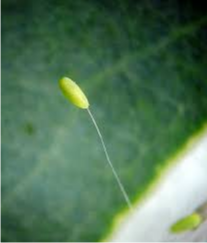
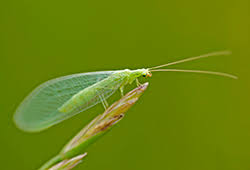
The percentage of o predation was from 0.6%. This low percentage of predation may be due to the small degree of synanthropy of this species.
It was observed that a Chrysoperla externa larva (Hagen, 1861) feeds on 567.4 eggs of Diatraea saccharalis (Fabricius, 1794) (Lepidoptera, Crambidae); 930.2 eggs of Sitotroga cerealella (Oliver, 1819) (Lepidoptera, Gelechiidae) and 1553 eggs of Anagasta kuehniella (Zeller, 1879) (Lepidoptera, Pyralidae) [6].
Adults are usually greenish in color, with a delicate body, reticulated membranous wings and legs. normal outpatient clinics. The head is free, hypognathic, chewing mouthparts and filiform antennae. During the day are found landed on the undersides of leaves and at night are seen flying or landing near bright spots [7].
The green lacewing C. externa presents a wide geographical distribution and is native of the Neotropical Region. Also presents a broad geographical distribution in North and South America. Both are predators frequently found in the tomato crop [8]
Green lacewings are the most studied insects within the order Neuroptera, due to its wide occurrence and recognized importance as biological control agents, as they are voracious predators in the larval stages, having a high reproductive potential, great capacity for searching for larvae and tolerance to some insecticides, in the specific case of certain species [9].
3. Conclusion
Due to the importance of these arthropods, their biological control has been studied as an alternative to chemical control, which is a good ecological and environmental strategy.
References
- Almazán, C.; Villar, R.L.; Canales, M.; Rosario-Cruz, R.; Jongejan, F.; Fuente, J. . Parasitol. Res. 2010, 106, 471–479. doi:10.1007/s00436-009-1689-1.[CrossRef] [PubMed]
- Higa, L.O.S.; Garcia, M.V.; Barros, J.C.; Koller, W.W.; Andreotti, R. Evaluation of Rhipicephalus (Boophilus) microplus (Acari: Ixodidae) resistance to different acaricide formulations using samples from Brazilian properties. Rev. Bras. Parasitol. Vet. 2016, 163-171. doi:10.1590/S1984-29612016026.[CrossRef] [PubMed]
- Shi, H.; Duan, L.L.F.; Hu, Y.; Shi, Z; Chen, X.; ,; Yan, B.; Yao, L. Rhipicephalus (Boophilus) microplus ticks as reservoir and vector of 'Candidatus Mycoplasma haemobos' in China. doi:.[CrossRef] [PubMed]
- Freitas, S. O uso de crisopídeos no controle biológico de pragas. São Paulo, SP, Brazil, 2002; pp 209–224.
- Figueira, L.K.; Carvalho, C.F.; Souza, B. Biologia e exigências térmicas de Chrysoperla externa (Hagen, 1861) (Neuroptera: Chrysopidae) alimentada com ovos de Alabama argillacea (Hübner, 1818) (Lepidoptera: Noctuidae). Cienc. Agrotec. 2000. 24, 319-326.
- Medeiros, M.A; Ribeiro, P.A.; Morais, H.C.; Castelo Branco, M.; Sujii, E.R.; Salgado-Laboriau, M.L. Identification of plant families associated with the predators Chrysoperla externa (Hagen) (Neuroptera: Chrysopidae) and Hippodamia convergens Guérin-Menéville (Coleoptera: Coccinelidae) using pollen grain as a natural marker. Braz. J. Biol. 2010, 70, 293-300. .[CrossRef] [PubMed]
- Lavagnini, T.C.; Freitas, S.F.; Bezerra, A.L. Aspectos biológicos de Chrysoperla raimundoi Freitas & Penny (Neuroptera, Chrysopidae). Biologia, Ecologia e Diversidade. Rev. Bras. Entomol. 2009, 53, 629–634.[CrossRef]
- Soares, J.J.; Macêdo, L.P.M. Criação de Crysoperla Externa para o Controle Biológico de Pragas do Algodoeiro. Embrapa: Campina Grande PB, Brazil, 2000; pp. 1-9.[Source Link]
- Lira, R.S.; Batista, J.L. Aspectos biológicos de Chrysoperla externa alimentados com pulgões da erva-doce. Rev. Biol. Cien. Terra. 2006, 6.[Source Link]